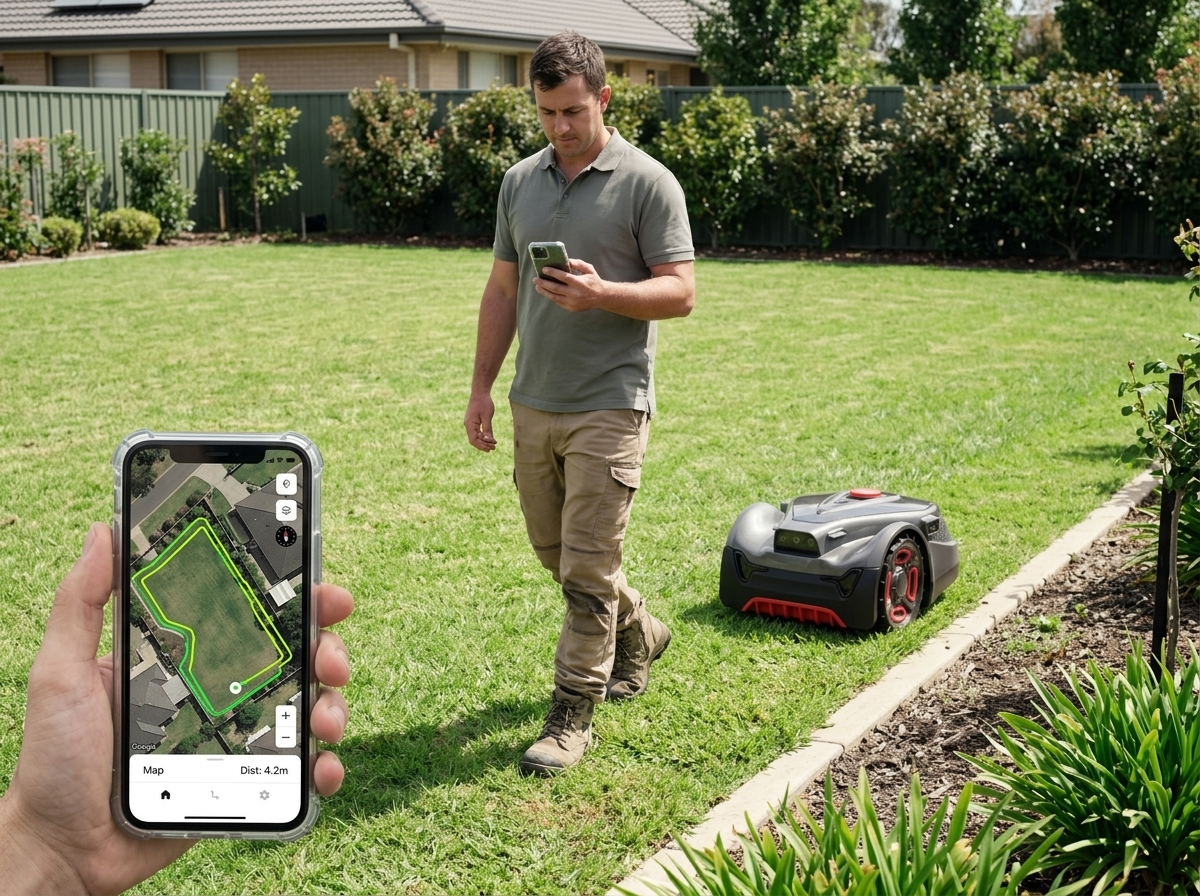
You head out for the weekend, and when you come back, your lawn is trimmed without you lifting a finger. It almost feels like magic, but robotic lawn mowers use a surprisingly sophisticated blend of engineering and smart technology to get the job done. Understanding how a robotic lawn mower works helps you choose a system that fits your yard, your terrain, and your peace of mind.
From the moment it leaves the charging dock to the second it glides past a garden gnome without a pause, every robotic mower follows a precise, technology-driven routine. We'll break down the navigation systems—including GPS lawn mower navigation versus traditional boundary wires—the sensors that keep it safe, and the cutting mechanics that quietly maintain that golf-course-quality finish. By the end, you'll know exactly what's happening under the hood, and whether this technology is ready to take over your Saturday mowing.

What Is a Robotic Lawn Mower and How Does the Core System Work
A robotic lawn mower is a battery-powered autonomous machine that cuts grass with almost zero hands-on effort. It uses onboard sensing, smart control, and precise navigation to move across your yard, dodge obstacles, and cover every patch of lawn on its own.
Five interconnected modules make this possible:
Navigation module – Builds spatial awareness and plots routes using GNSS/RTK, LiDAR, cameras, or boundary-based mapping. High-end commercial units achieve RTK coverage up to 1 km, with some LiDAR-equipped models offering positioning precision as tight as 0.79 inches.
Obstacle avoidance module – Combines ultrasonic sensors, LiDAR, and AI vision to spot hazards in real time. Some robotic mower sensors recognize over 200 distinct obstacle types and can detect objects as close as 1.97 inches away.
Cutting module – A spinning blade deck or linear blade assembly trims grass in small, repeated passes rather than one heavy cut.
Power module – Lithium batteries drive the whole operation. Specs vary: some models pack a 15Ah battery with up to 3 hours of runtime and fast charging (10% to 90% in 90 minutes), while larger units run 8 kWh, 48V systems delivering 10 hours of use with a 5-hour recharge.
Control module – The onboard "brain" coordinates every function: movement, cutting activation, sensor input, and emergency stops. When an obstacle appears, the control system tells the mower to halt, reverse, and reroute instantly.
Autonomous vs. Traditional Mowing
Traditional mowers remove a large volume of grass in one manual pass. Robotic mowers work differently. They perform frequent, small trims, returning to the same area repeatedly to maintain height. This approach reduces cutting load per pass, which is why battery-powered operation becomes practical.
Some smarter models even skip cutting when no grass is detected, stretching battery life further while keeping the lawn manicured between charges.
Navigation Technology: Boundary Wire vs GPS/RTK Lawn Mower Systems
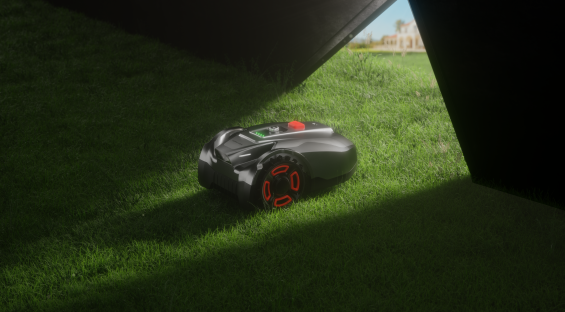
Two navigation types dominate the robotic mower market. Picking the wrong one for your yard can turn a flawless cut into constant frustration. Both boundary wire and GPS lawn mower navigation keep the machine inside your lawn and away from flower beds, but they use very different engineering.
Boundary Wire Systems
A boundary wire works by running a low-voltage perimeter cable that generates a magnetic field. The mower's sensors detect this field and steer back whenever it senses the edge. Installation follows specific rules. The wire typically sits about 40 cm from the lawn edge, held down with pegs, with at least 2 meters of straight wire in front of the charging station. Most guides warn against corners tighter than 120°, and many systems cap total wire length at 300 meters. For durability, you can bury the wire 1–20 cm into the ground.
Accuracy is around 5–10 cm of boundary tolerance—not bad, but not razor-sharp either. Wire systems don't need satellite visibility, so they perform reliably under dense trees, near sheds, or in narrow side yards. The downside: installation takes real labor, and any layout change means digging up and re-laying wire.
RTK (Real-Time Kinematic) technology pairs a fixed base station with the mower's rover receiver to correct standard GNSS errors instantly. Plain GPS gives about 2–3 meters of accuracy, but RTK correction tightens that to 1–3 cm. Some technical specs cite 1 cm ± 2 ppm horizontally and 2 cm ± 2 ppm vertically under good conditions.
RTK needs a base station mounted high and stable, with a clear sky view, away from sheds, trees, and metal roofs. Signal quality drops fast under tree canopy or near buildings due to sky masking and multipath interference.
Hybrid Systems
Hybrid setups combine GNSS with vision, IMU, or LiDAR-based robot mower mapping technology, so when satellite signal weakens, the mower switches to onboard sensing to keep moving safely. Reported accuracy ranges are LiDAR ±2 cm, RTK ±3–5 cm, and AI vision ±5–10 cm. This makes hybrid ideal for mixed yards with fence lines, garden islands, or partial canopy coverage, though the added hardware pushes cost higher than wire-only models.
Quick Selection Guide
Boundary wire: small-to-medium lawns, tight corners, budget-first priority
RTK: open yards needing centimeter precision and fast virtual boundary edits
Hybrid: properties with both open sky and obstruction zones
Robotic Mower Obstacle Detection and Safety Sensor Systems
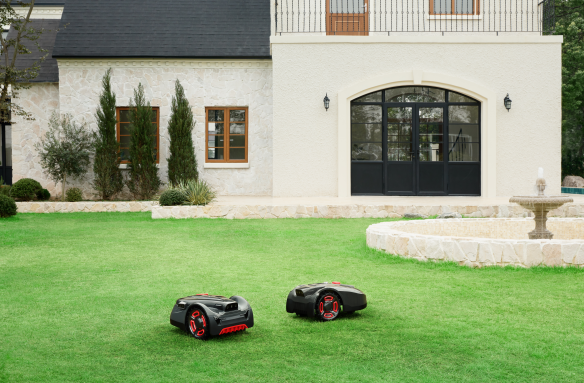
A garden hose, a sleeping cat, a toddler's ball—robotic mower obstacle detection has to handle all of it without slicing through anything living. Manufacturers layer multiple technologies to pull this off, and the sophistication varies a lot between entry-level and premium models.
Bump/Collision Detection
Entry-level machines use front bumpers or floating chassis sensors. The mower physically touches an obstacle, stops the blade, reverses, and reroutes. This contact-then-react method works fine for fixed objects like tree trunks, but it struggles with low, soft targets—pets, crawling children, or hedgehogs—since there's no advance warning before contact.
Ultrasonic and Radar Systems
Ultrasonic sensors improve on this by detecting objects before they're touched. Industry guidance places transducers at the front, angled outward and above ground level to cut down on false readings from grass reflection. A common safety threshold treats anything within 15 cm as an immediate threat, triggering a course change. Mid-to-high-end units detect obstacles between 20–80 cm away, giving the mower room to slow or steer around hazards before reaching that critical zone. Some brands, including Husqvarna, add radar for continuous forward scanning, which pairs well with on-chip tracking for smaller, harder-to-spot objects.
Camera-Based AI Vision
Vision systems push robotic mower sensors further. Multi-camera setups and time-of-flight sensors cover up to a 300° field, distinguish trees, flower beds, and walls from moving targets like children, pets, and toys, and identify them before any contact occurs.
Sensor Fusion and Tilt Protection
Top-tier robotic lawn mowers layer bumpers, ultrasonic, radar, and vision together. Bumpers handle last-resort contact protection, ultrasonic and radar manage mid-range warnings, and AI vision classifies complex targets. Tilt sensors round out the safety net, cutting power when the mower tips beyond 20–30°, preventing rollovers on slopes.
The Cutting Mechanism: How Robotic Mower Blades Trim Your Lawn
Grass doesn't get chopped by a robotic mower—it gets shaved. That distinction explains a lot about why these machines produce such a clean finish without the noise and effort of a traditional mower.
The Blade Setup
Most robotic mowers use a spinning disc fitted with 2–4 small pivoting razor blades. Cutting widths on consumer models run 16 cm to 28 cm, while higher-end dual rotary mulching systems reach 16 inches (405 mm) wide and spin at speeds around 6,000 RPM. The pivoting design matters: on impact with a stick or stone, the blades swing back instead of snapping, which reduces damage compared to a rigid fixed blade.
Shearing, Not Chopping
The action is closer to scissoring than hitting. The disc spins fast, and the razor edge slices the grass tip cleanly—that's why these cuts are often described as precision trims rather than the "machete" effect of a traditional rotary blade.
Little and Often
Robotic mowers work best on a schedule of daily to every-other-day trims, sometimes bi-weekly depending on growth rate. Each pass removes only a small amount of growth, which keeps stress on the turf low compared to infrequent, heavy cuts. Cutting height adjusts between 30–100 mm (1.2–4 inches).
Mulching Benefits
These machines are mulch-only—clippings stay on the lawn rather than getting bagged. Because the fragments are so fine, they decompose quickly, returning nitrogen to the soil and cutting down on yard waste. Some decks use airflow fans to keep clippings circulating longer for finer mulching.
Maintenance Notes
Blade sets are inexpensive, usually $5–$20 per full set, and designed for quick swaps. Most robotic mower blades tolerate twigs up to about 7 mm in diameter before performance drops, so light debris usually isn't a problem.
8 Steps of a Robotic Lawn Mower's Daily Routine
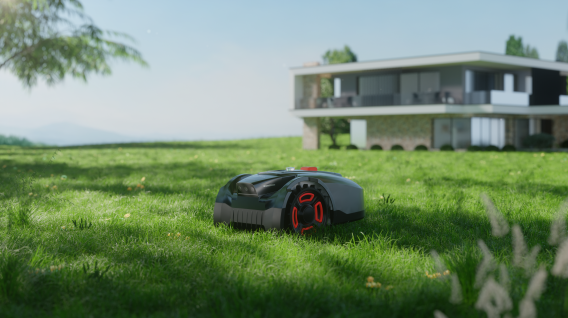
The mower cycles through the same eight tasks every single day: boundary setup, map learning, path planning, mowing, obstacle rerouting, low-battery return, docking, and resuming.
Setup and Mapping
Before a mower can run on its own, you have to define the boundaries. Wire-based systems need at least 2 meters of straight guide wire in front of the charging station, with 50 cm clearance on the sides. Some models require 1.5 meters of straight wire on each side of the dock to align properly when docking.
Mowers with mapping capability learn the yard layout first, identifying pathways between mowing zones and the charging station. Skip this step, and the mower can't find its way home if there's no recognized channel.
Mowing and Obstacle Handling
Most mowers leave the dock once the battery reaches around 80%. Mowing continues in a loop, slowing down, rerouting, or stopping when obstacles appear, until the battery drops to a low threshold, typically 10–15%. At that point, the mower stops cutting and heads back.
Three Mowing Patterns
Random mode uses simple bounce-and-turn logic, common on budget models without detailed maps. Coverage is uneven, but it needs minimal computing power.
Systematic mode runs parallel lines or grid patterns across mapped zones. Some mowers switch from random to systematic automatically when entering narrow corridors, which boosts throughput.
Hybrid mode blends random exploration in open areas with systematic passes in mapped zones or tight channels. It's generally the most time-efficient balance for complex yards.
Docking and Battery Management
Returning to the charging station means centering the chassis so the charging contacts touch the base completely. Docking failures usually come down to blocked stations, weak signal, or dirty contacts. Full charging from empty takes about 80–100 minutes. Manufacturers recommend keeping batteries topped up, and some manuals suggest a full charge every 90 days during storage to prevent deep discharge damage.
Common Questions About How Robotic Lawn Mowers Work (FAQ)
Is a robotic lawn mower quiet?
Yes. Most units run at 54–65 dB, about the volume of a normal conversation. Compare that to gas mowers at 85–100 dB or electric push mowers at 70–80 dB, and you'll understand why owners can run these machines at 7 a.m. without waking the neighborhood.
How long does the battery last before replacement?
Expect 3–5 years from a standard lithium battery pack under normal use. Replacement costs €140–€370 ($150–$300), depending on capacity and model. This is separate from the daily runtime discussed earlier. It's the pack's overall lifespan.
How often do blades need replacing?
Active-use lawns wear through blade sets every 1–3 months. A fresh set runs $20–$50, cheap insurance for a clean, mulch-quality cut.
Is a robotic mower cheaper over time?
Numbers vary. One study found electric/robot operating costs (electricity, blades, battery) land around €185–€550 ($250–$740) over five years, versus €1,400–€1,850 for gas mower fuel, oil, and filters. A direct model comparison showed a €399 robot mower beating a €775 petrol mower in total five-year cash outlay. Another broader estimate puts robot ownership at €1,500–€3,200 over five years against €3,600–€4,100 for gas equivalents.
What's the upfront price difference?
Robot mowers cost $700–$5,000 (€1,199–€2,999). Gas or push mowers run $150–$1,500 (€250–€750). Traditional mowers win on sticker price; robots win on labor, noise, and long-term math.
How long does setup take?
Wire-free, GPS-based models can map a lawn in about 10 minutes through the app. Wire-based systems need several hours to half a day for boundary calibration. DIY installs often stretch 4–8 hours, sometimes two full days on complex properties. Professional installers typically finish in 3–5 hours for $200–$800.
Is it worth the switch?
Owners consistently report saving 30+ hours per year on mowing once setup is complete. Robots win on convenience, noise, and labor savings. Traditional mowers still win on lower upfront cost. Which side matters more depends on how much your Saturdays are worth to you.